Current Events

  • Kansas Legislator Proposes Bill to Outlaw Sustainability Education
    A bill has been introduced in the Kansas legislature this week that would prohibit the promotion of ...Read more

    x

    Kansas Legislator Proposes Bill to Outlaw Sustainability Education

    A bill has been introduced in the Kansas legislature this week that would prohibit the promotion of sustainability. Here is a link to the one-page bill: http://www.kslegislature.org/li/b2013_14/measures/documents/hb2366_00_0000.pdf. See report on Bloomberg News.
  • Earth's Center Is 1,000 Degrees Hotter Than Previously Thought, Synchrotron X-Ray Experiment Shows
    Scientists have determined the temperature near the Earth’s center to be 6000 degrees Celsius, 1000 ...Read more

    x

    Earth's Center Is 1,000 Degrees Hotter Than Previously Thought, Synchrotron X-Ray Experiment Shows

    Scientists have determined the temperature near the Earth’s center to be 6000 degrees Celsius, 1000 degrees hotter than in a previous experiment run 20 years ago. These measurements confirm geophysical models that the temperature difference between the solid core and the mantle above, must be at least 1500 degrees to explain why the Earth has a magnetic field. For more information about this study, see the press release from the European Synchrotron Radiation Facility.
  • Ocean Volcanic Rocks Contain Samples of Recycled Crust
    Scientists have long believed that lava erupted from certain oceanic volcanoes contains materials fr...Read more

    x

    Ocean Volcanic Rocks Contain Samples of Recycled Crust

    Scientists have long believed that lava erupted from certain oceanic volcanoes contains materials from the early Earth’s crust. But decisive evidence for this phenomenon has proven elusive. New research from a team including Carnegie’s Erik Hauri demonstrates that oceanic volcanic rocks contain samples of recycled crust dating back to the Archean era 2.5 billion years ago. Their work is published in Nature. Oceanic crust sinks into the Earth’s mantle at so-called subduction zones, where two plates come together. Much of what happens to the crust during this journey is unknown. Model-dependent studies for how long subducted material can exist in the mantle are uncertain and evidence of very old crust returning to Earth’s surface via upwellings of magma has not been found until now. For more information about these results, see the press release from the Carnegie Institution.
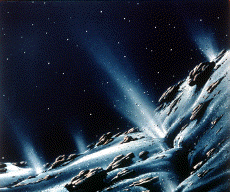
This is a drawing of what the surface of a comet might look like.
Click on image for full size
JPL

The Comet Nucleus

A comet nucleus is the very center of the comet. It is solid and is made of a special sort of dust which scientists call "fluffy". They call it fluffy because it is full of holes and could be very light.

At this point, scientists do not know whether the nucleus is very hard, like solid ground, or very soft, like a snowball.

Scientists are going to use the Rosetta mission to land a probe on the surface of a comet! This and other comet missions will certainly help scientists understand the very center of comets!

Last modified June 22, 2005 by Jennifer Bergman.

Shop Windows to the Universe Science Store!

Our online store includes issues of NESTA's quarterly journal, The Earth Scientist, full of classroom activities on different topics in Earth and space science, ranging from seismology, rocks and minerals, oceanography, and Earth system science to astronomy!

Windows to the Universe Community

News

Opportunities

You might also be interested in:

Cool It! Game

Check out our online store - minerals, fossils, books, activities, jewelry, and household items!...more

Brownlee Particles

This example of Interstellar Dust is a perfect example of the kind of rocky material comets may be made of. The grains themselves seem to be made of smaller grains. There are many holes, or pores. In a...more

Nucleus of Comet Wild 2

The pictures on this page show the nucleus of a comet. These are the best pictures ever made of the nucleus of a comet. The nucleus of a comet is a big lump of ice and dust. This one is about five kilometers...more

Comet Hale-Bopp

Comet Hale-Bopp was one of the brightest comets of all time. Astronomers witnessed the comet spew out intermittent bursts of dust. The surface seemed to be an incredibly dynamic place, with 'vents' being...more

CONTOUR on its Way to Catch a Comet!

NASA’s Comet Nucleus Tour (called CONTOUR) launched July 3, 2002. The CONTOUR spacecraft will fly by at least two comets. It will take pictures and collect dust from the nucleus of each comet. Learning...more

CONTOUR Lost in Space

We are sad to report that CONTOUR is lost in space. The CONTOUR spacecraft was launched July 3, 2002 to explore the nucleus of comets. It was to take pictures and catch dust from the nucleus of at least...more

The Stardust mission to a comet

Stardust is the name of a space mission that studied a comet. Stardust flew very close to the comet in January 2004. It took some very good pictures of the nucleus of the comet. It also grabbed some dust...more

Comet Churyumov-Gerasimenko

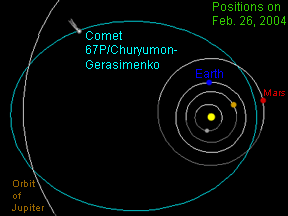
Comet Churyumov-Gerasimenko was discovered in 1969. It is named after the two scientists who found it, Klim Churyumov and Svetlana Gerasimenko. The comet goes around the Sun once every 6.57 years. The...more

Shop Windows to the Universe

Learn about planets outside our solar system through Exoplanets and Alien Solar Systems by Tahir Yaqoob, Ph.D., a book in our online store book collection.

Windows to the Universe, a project of the National Earth Science Teachers Association, is sponsored in part by the National Science Foundation and NASA, our Founding Partners (the American Geophysical Union and American Geosciences Institute) as well as through Institutional, Contributing, and Affiliate Partners, individual memberships and generous donors. Thank you for your support! NASA AGU AGI NSF