Current Events

  • Irish Chronicles Document Links Between Volcanoes and Weather
    A study of over 40,000 written entries in Irish Annals and ice core measurements shows a strong corr...Read more

    x

    Irish Chronicles Document Links Between Volcanoes and Weather

    A study of over 40,000 written entries in Irish Annals and ice core measurements shows a strong correlation between the occurrence of volcanic eruptions and extreme cold weather in Ireland over a 1200 year period. Data analyzed in this study cover the period from 431 to 1649, during which time up to 48 volcanic eruptions are identified in Greenland ice core records through deposition of volcanic sulfate in annual layers of ice. You can find the study (open access), published on 6 June 2013 in IOP Publishing's journal Environmental Research Letters, at http://iopscience.iop.org/1748-9326/8/2/024035/article. Find out more about how volcanoes can influence climate.
  • EF-5 Tornado in El Reno, Oklahoma Widest Ever Recorded in US
    The EF-5 tornado that hit El Reno, Oklahoma on May 31st was the widest ever recorded in the US, acco...Read more

    x

    EF-5 Tornado in El Reno, Oklahoma Widest Ever Recorded in US

    The EF-5 tornado that hit El Reno, Oklahoma on May 31st was the widest ever recorded in the US, according to the National Weather Service in Norman Oklahoma. The tornado, which remained on the ground for 40 minutes and reached 2.6 miles across (4.2 km), took the lives of 18 people including storm chasers Tim Samaras, Paul Samaras and Carl Young. For more information on the tornado, visit http://ow.ly/i/2hfDG.
  • Atmospheric CO2 Level Tops 400 ppm
    During the week of May 13th, the CO2 level at the Mauna Loa Observatory in Hawaii topped 400 ppm rep...Read more

    x

    Atmospheric CO2 Level Tops 400 ppm

    During the week of May 13th, the CO2 level at the Mauna Loa Observatory in Hawaii topped 400 ppm repeatedly. Daily levels of CO2 can vary due to weather, and there are seasonal trends as well. The level of atmospheric greenhouse gases continues to increase, now over 120 ppm since the Industrial Revolution began. For more on the Keeling Curve, see http://keelingcurve.ucsd.edu/. Find out more about greenhouse gases and warming.
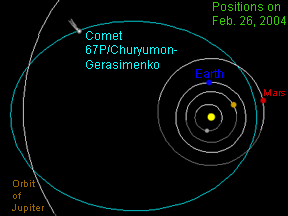
This image shows the orbit of Comet Churyumov-Gerasimenko in aqua. The positions of the comet and planets are shown for February 26, 2004, the planned launch date for the Rosetta mission.
Click on image for full size
Windows to the Universe original artwork by Randy Russell.

Comet Churyumov-Gerasimenko

Comet 67P/Churyumov-Gerasimenko was discovered in 1969 by Klim Churyumov and Svetlana Gerasimenko. The comet orbits the Sun once every 6.57 years. Its orbit brings it closer to the Sun than Mars at the closest point (called "perihelion"), and swings it a bit beyond the orbit of Jupiter at its furthest point from the Sun (called "aphelion").

This comet has an odd history. Before 1840 the comet had an orbit that kept it pretty far from the Sun. In 1840 it got close to Jupiter. The strong gravity of Jupiter changed the comet's orbit, moving it closer to the Sun. Another close approach near Jupiter in 1959 moved the comet even closer in. Since the comet was far from the Sun until recent times, it hasn't melted very much. That means it hasn't changed very much since it was "born" when our Solar System was young. Scientists want to study comets like this because they may help the scientists learn about the early times in the history of our Solar System.

The Rosetta space mission will visit this comet in 2014. The spacecraft includes a lander that will touch down on the surface of the comet's nucleus. Scientists think the nucleus of Comet Churyumov-Gerasimenko is about 3 km wide by 5 km long (about 2 miles by 3 miles).

Last modified March 19, 2004 by Jennifer Bergman.

Shop Windows to the Universe Science Store!

Our online store includes books on science education, classroom activities in The Earth Scientist, mineral and fossil specimens, and educational games!

Windows to the Universe Community

News

Opportunities

You might also be interested in:

Cool It! Game

Check out our online store - minerals, fossils, books, activities, jewelry, and household items!...more

Solar System Formation

Scientists believe that the solar system was formed when a cloud of gas and dust in space was disturbed, maybe by the explosion of a nearby star (called a supernova). This explosion made waves in space...more

Rosetta instruments

The Rosetta spacecraft has many instruments that it will use to measure Comet Churyumov-Gerasimenko during its visit. This diagram shows the two cameras that make up the OSIRIS imaging system: the Narrow-Angle...more

Rosetta lander instruments

The Rosetta lander has many instruments that it will use to make measurements when it lands on Comet Churyumov-Gerasimenko. The instruments carried by the lander are described in the table below. The instruments...more

Asteroid Lutetia

Lutetia is a medium-sized asteroid. It orbits the Sun in the main asteroid belt between the planets Mars and Jupiter. Its official name is "21 Lutetia" because it was the 21st asteroid discovered. Lutetia...more

Rosetta Flyby of Asteroid Lutetia

Rosetta is a European space probe. It was launched in 2004. Its main mission is to fly to a comet and land on it. Along the way it has flown by two asteroids. In July 2010 it flew by an asteroid named...more

Comet Churyumov-Gerasimenko

Comet 67P/Churyumov-Gerasimenko was discovered in 1969 by Klim Churyumov and Svetlana Gerasimenko. The comet orbits the Sun once every 6.57 years. Its orbit brings it closer to the Sun than Mars at the...more

Comet Hale-Bopp

Hale-Bopp continues to offer new surprises as two astronomers report of their study of the comet. Using the Hubble Space Telescope and the International Ultraviolet Explorer, the astronomers did a year-long...more

Shop Windows to the Universe

Science, Evolution, and Creationism, by the National Academies, focuses on teaching evolution in today's classrooms. Check out the other publications in our online store.

Windows to the Universe, a project of the National Earth Science Teachers Association, is sponsored in part by the National Science Foundation and NASA, our Founding Partners (the American Geophysical Union and American Geosciences Institute) as well as through Institutional, Contributing, and Affiliate Partners, individual memberships and generous donors. Thank you for your support! NASA AGU AGI NSF