This image shows the orbit of Comet Churyumov-Gerasimenko in aqua. The positions of the comet and planets are shown for February 26, 2004, the planned launch date for the Rosetta mission.
Click on image for full size
Windows to the Universe original artwork by Randy Russell.
Comet Churyumov-Gerasimenko
Comet 67P/Churyumov-Gerasimenko was discovered in 1969 by Klim Churyumov and
Svetlana Gerasimenko. The comet orbits the Sun once
every 6.57 years. Its orbit brings it closer to the Sun than Mars at
the closest point (called "perihelion"),
and swings it a bit beyond the orbit of Jupiter at
its furthest point from the Sun (called "aphelion").
This comet has an odd history. Before 1840 the comet had an orbit that kept
it pretty far from the Sun. In 1840 it got close to Jupiter. The strong gravity
of Jupiter changed the comet's orbit, moving it closer to the Sun. Another
close approach near Jupiter in 1959 moved the comet even closer in. Since the
comet was far from the Sun until recent times, it hasn't melted very much.
That means it hasn't changed very much since it was "born" when our Solar
System was young. Scientists want to study comets like this because they may help
the scientists learn about the early
times in the history of our Solar System.
The Rosetta
space mission will visit this comet in 2014. The spacecraft includes a lander that will touch down on the surface of the comet's nucleus. Scientists think
the nucleus of Comet Churyumov-Gerasimenko is about 3 km wide by 5 km long
(about 2 miles by 3 miles).
You might also be interested in:
Scientists believe that the solar system was formed when a cloud of gas and dust in space was disturbed, maybe by the explosion of a nearby star (called a supernova). This explosion made waves in space
...more
The Rosetta spacecraft has many instruments that it will use to measure Comet Churyumov-Gerasimenko during its visit. This diagram shows the two cameras that make up the OSIRIS imaging system: the Narrow-Angle
...more
The Rosetta lander has many instruments that it will use to make measurements when it lands on Comet Churyumov-Gerasimenko. The instruments carried by the lander are described in the table below. The instruments
...more
Lutetia is a medium-sized asteroid. It orbits the Sun in the main asteroid belt between the planets Mars and Jupiter. Its official name is "21 Lutetia" because it was the 21st asteroid discovered. Lutetia
...more
Rosetta is a European space probe. It was launched in 2004. Its main mission is to fly to a comet and land on it. Along the way it has flown by two asteroids. In July 2010 it flew by an asteroid named
...more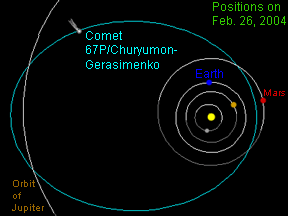
Comet 67P/Churyumov-Gerasimenko was discovered in 1969 by Klim Churyumov and Svetlana Gerasimenko. The comet orbits the Sun once every 6.57 years. Its orbit brings it closer to the Sun than Mars at the
...more
Hale-Bopp continues to offer new surprises as two astronomers report of their study of the comet. Using the Hubble Space Telescope and the International Ultraviolet Explorer, the astronomers did a year-long
...more