The tiny blue and purple dots in this picture show where Kuiper Belt Objects are. See how they are out past Neptune, near Pluto?
Click on image for full size
Image courtesy NASA/JPL-Caltech.
The Kuiper Belt
You might think that space out near
Pluto is pretty empty and lonely. Guess what, it isn't! There are thousands and thousands of giant balls of ice and rock out there. Those giant balls are called Kuiper Belt Objects, or KBOs for short. The Kuiper Belt is a bit like the
asteroid belt.
The Kuiper Belt is much farther from the Sun than the asteroid belt. The Kuiper Belt is out near Pluto. There are thousands and thousands of KBOs. Some are small. Some are bigger. Some might be as big as Pluto, or even bigger! Scientists aren't quite sure whether big KBOs are planets or not.
Pluto is a planet, but it is also a KBO. Other than Pluto, the first KBO was discovered in 1992. It has a weird name. Its name is name "1992 QB1". Astronomers have found hundreds more KBOs since 1992.
The Kuiper Belt is named after Gerard Kuiper. Gerard Kuiper was an astronomer. Before the Kuiper Belt was found, he said that some comets probably came from the Kuiper Belt. He was right.
The Oort Cloud is another part of the edge of our Solar System. The Oort Cloud is not the same as the Kuiper Belt. The Oort Cloud is much, much further away. Sometimes people talk about the Oort Cloud and the Kuiper Belt together. They call the whole combined thing "Trans-Neptunian Objects", or TNOs for short. All of the TNOs are further from the Sun than the planet Neptune.
Most KBOs have weird names. Some of the most famous KBOs are Pluto, 1992 QB1, Orcus, Quaoar, Ixion, and Varuna.
You might also be interested in:

Pluto has the strangest orbit of all the planets in the solar system. The orbit comes inside the orbit of Neptune. This means Pluto is the 8th planet rather than the 9th planet for about 20 years at a
...more
Mathematical theory suggests that most comets may come to the solar system from very far away. In this picture, the solar system is buried deep within the cloud. An AU is the distance from the earth to
...more
Scientists have found something new in the solar system! They found a far-away object far beyond Pluto by looking with the Hubble Space Telescope. The scientists call their discovery Quaoar. It is 4 billion
...more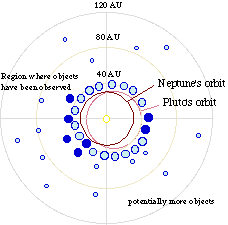
Beyond the orbit of Pluto is a region which contains objects which look like planetismals. The objects are very small, and not very bright. It takes hundreds of years for these objects to go around the
...more
A spacecraft is going to Pluto! The name of the spacecraft is New Horizons. New Horizons will be the first spacecraft ever to go to Pluto! Pluto is very, very far away. It will take New Horizons nine years
...more
Haumea was a goddess in Hawaiian mythology. She was the goddess of childbirth. One of her children was the volcano and fire goddess Pele. Her children also included the sea goddess Namaka and Hi'iaka -
...more
Haumea is a dwarf planet in our Solar System. Haumea is officially the fifth dwarf planet. The four that came before it are Pluto, Eris, Ceres, and Makemake. Haumea officially became a dwarf planet in
...moreHaumea is a dwarf planet in our Solar System. Haumea has // Call the moon count function defined in the document head print_moon_count('haumea'); known moons, both discovered in 2005. Hi'iaka is the larger
...more