Current Events

  • Irish Chronicles Document Links Between Volcanoes and Weather
    A study of over 40,000 written entries in Irish Annals and ice core measurements shows a strong corr...Read more

    x

    Irish Chronicles Document Links Between Volcanoes and Weather

    A study of over 40,000 written entries in Irish Annals and ice core measurements shows a strong correlation between the occurrence of volcanic eruptions and extreme cold weather in Ireland over a 1200 year period. Data analyzed in this study cover the period from 431 to 1649, during which time up to 48 volcanic eruptions are identified in Greenland ice core records through deposition of volcanic sulfate in annual layers of ice. You can find the study (open access), published on 6 June 2013 in IOP Publishing's journal Environmental Research Letters, at http://iopscience.iop.org/1748-9326/8/2/024035/article. Find out more about how volcanoes can influence climate.
  • EF-5 Tornado in El Reno, Oklahoma Widest Ever Recorded in US
    The EF-5 tornado that hit El Reno, Oklahoma on May 31st was the widest ever recorded in the US, acco...Read more

    x

    EF-5 Tornado in El Reno, Oklahoma Widest Ever Recorded in US

    The EF-5 tornado that hit El Reno, Oklahoma on May 31st was the widest ever recorded in the US, according to the National Weather Service in Norman Oklahoma. The tornado, which remained on the ground for 40 minutes and reached 2.6 miles across (4.2 km), took the lives of 18 people including storm chasers Tim Samaras, Paul Samaras and Carl Young. For more information on the tornado, visit http://ow.ly/i/2hfDG.
  • Atmospheric CO2 Level Tops 400 ppm
    During the week of May 13th, the CO2 level at the Mauna Loa Observatory in Hawaii topped 400 ppm rep...Read more

    x

    Atmospheric CO2 Level Tops 400 ppm

    During the week of May 13th, the CO2 level at the Mauna Loa Observatory in Hawaii topped 400 ppm repeatedly. Daily levels of CO2 can vary due to weather, and there are seasonal trends as well. The level of atmospheric greenhouse gases continues to increase, now over 120 ppm since the Industrial Revolution began. For more on the Keeling Curve, see http://keelingcurve.ucsd.edu/. Find out more about greenhouse gases and warming.
This image of the nucleus of Halley's comet comes from the Giotto spacecraft.
Click on image for full size
JPL

Halley's comet

Halley's comet is named after Edmond G. Halley who was the first to suggest that comets were natural phenomena of the solar system, in orbit around the Sun. He suggested that a certain comet was a regular visitor, returning every 76 years, and was, in fact, the same one which had been observed since 240 BC, but in particular in the years 1531, 1607, and 1682, dates which for him were recent history. In 1682 he predicted the comet would return again in 1758, and sure enough, the comet arrived in March 1759. Halley's comet made a particularly bright appearance in 1910. It also was recorded in a famous ancient tapestry after its 1066 appearance.

For hundreds of years humankind has wondered what the nucleus of Halley's comet was really like. This wonderful picture from the Giotto spacecraft gives us the answer. In this picture, the Sun is on the left. Three jets can be seen blowing molecules toward the Sun. A crater can also be seen in the middle right. This image shows that evaporation occurs along specific portions of the comet. Data taken by a suite of spacecraft suggests that the comet is mostly made of ice.

Halley's comet is next scheduled to return in 2062.

Last modified December 6, 2000 by Jennifer Bergman.

Shop Windows to the Universe Science Store!

Our online store includes books on science education, classroom activities in The Earth Scientist, mineral and fossil specimens, and educational games!

Windows to the Universe Community

News

Opportunities

You might also be interested in:

Traveling Nitrogen Classroom Activity Kit

Check out our online store - minerals, fossils, books, activities, jewelry, and household items!...more

Missions to Halley's comet in 1986

Six spacecraft flew by Halley's comet in 1986. There were two spacecraft launched from Japan, Suisei and Sakigake, and two from the Soviet Union, Vega 1 & 2. One spacecraft, ICE, from the United States...more

When a Comet comes close to the Sun

When comets are kicked out of the Oort Cloud, they begin a passage into the solar system, spinning and tumbling as they come. The trajectory which they acquire can be hyperbolic, parabolic, or elliptic...more

Eccentricity of an Orbit

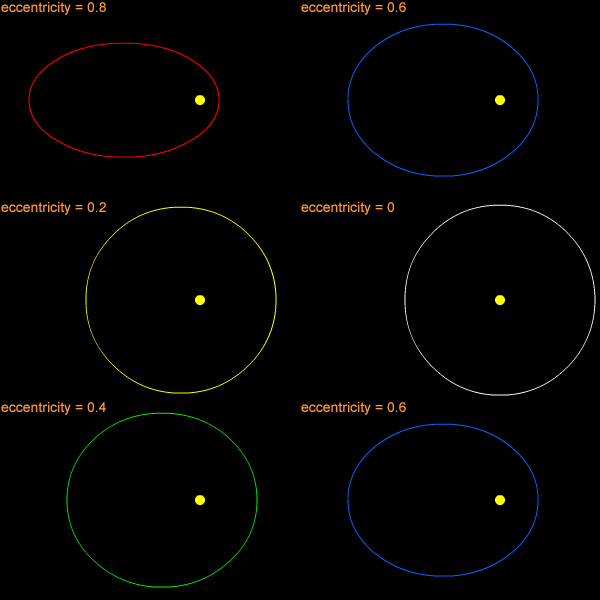
You may think that most objects in space that orbit something else move in circles, but that isn't the case. Although some objects follow circular orbits, most orbits are shaped more like "stretched...more

Orionid Meteor Shower

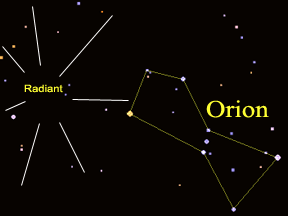
The Orionid meteor shower happens every year in October. Meteor showers are times when you can see many meteors or "shooting stars" in one night. There are several meteor showers each year. Most meteor...more

Leonid Meteor Shower

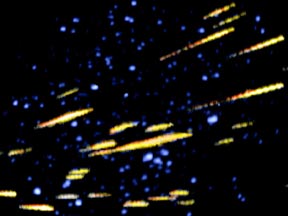
The Leonid meteor shower is one of several major meteor showers that occur on roughly the same date each year. The Leonids typically "peak" (are at their greatest level of activity) in mid to late November....more

Meteor Showers

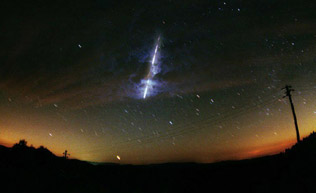
A meteor shower is an astronomical event during which many meteors can be seen in a short period of time. Most meteor showers have a peak activity period that lasts between several hours and a couple of...more

Comet Hale-Bopp

Hale-Bopp continues to offer new surprises as two astronomers report of their study of the comet. Using the Hubble Space Telescope and the International Ultraviolet Explorer, the astronomers did a year-long...more

Shop Windows to the Universe

Our Glaciers: Then and Now activity kit helps you see the changes taking place in glaciers around the world. See all our activity kits and classroom activities.

Windows to the Universe, a project of the National Earth Science Teachers Association, is sponsored in part by the National Science Foundation and NASA, our Founding Partners (the American Geophysical Union and American Geosciences Institute) as well as through Institutional, Contributing, and Affiliate Partners, individual memberships and generous donors. Thank you for your support! NASA AGU AGI NSF