Current Events

  • Atmospheric CO2 Level Tops 400 ppm
    During the week of May 13th, the CO2 level at the Mauna Loa Observatory in Hawaii topped 400 ppm rep...Read more

    x

    Atmospheric CO2 Level Tops 400 ppm

    During the week of May 13th, the CO2 level at the Mauna Loa Observatory in Hawaii topped 400 ppm repeatedly. Daily levels of CO2 can vary due to weather, and there are seasonal trends as well. The level of atmospheric greenhouse gases continues to increase, now over 120 ppm since the Industrial Revolution began. For more on the Keeling Curve, see http://keelingcurve.ucsd.edu/. Find out more about greenhouse gases and warming.
  • Massive Tornado Outbreak on Tornado Alley
    The week of May 19 brings dozens of tornadoes to Tornado Alley in the states of Oklahoma, Kansas, Io...Read more

    x

    Massive Tornado Outbreak on Tornado Alley

    The week of May 19 brings dozens of tornadoes to Tornado Alley in the states of Oklahoma, Kansas, Iowa, Illinois and Missouri. On May 20th, a massive tornado struck Moore, Oklahoma, devastating communities - destroying over 100 homes and hitting two elementary schools and a hospital - with many casualties and deaths. Our thoughts are with our friends and colleagues suffering from these storms. For more on the May 20th storms, see the NOAA Storm Prediction Center Storm Report.
  • Kansas Legislator Proposes Bill to Outlaw Sustainability Education
    A bill has been introduced in the Kansas legislature this week that would prohibit the promotion of ...Read more

    x

    Kansas Legislator Proposes Bill to Outlaw Sustainability Education

    A bill has been introduced in the Kansas legislature this week that would prohibit the promotion of sustainability. Here is a link to the one-page bill: http://www.kslegislature.org/li/b2013_14/measures/documents/hb2366_00_0000.pdf. See report on Bloomberg News.
This is one of the latest images of comet Hale-Bopp. Notice the intense tail
Click on image for full size
National Astronomical Observatory of Japan

Comet Hale-Bopp

Hale-Bopp continues to offer new surprises as two astronomers report of their study of the comet. Using the Hubble Space Telescope and the International Ultraviolet Explorer, the astronomers did a year-long study on Hale-Bopp to find that their are distinctly different ices in the comet's nucleus, the nucleus is huge, and the nucleus is extremely active.

The comet's nucleus seems to be erupting upon itself. Astronomers witnessed the comet spew out dust in intermittent bursts. The surface seems to be an incredibly dynamic place, with 'vents' being turned on and off as new patches of icy material are rotated into sunlight for the first time.

The nucleus' structure itself is more complex than astronomers had thought. Astonomers theorized that trace gases were contained within water ice. According to Hubble Space Telescope observations, however, Hale-Bopp's nucleus has trace components contained within their own ice structure, with water ice remaining separate and uniform.

In addition, the nucleus is tremendously large. Astronomers have estimated Hale-Bopp's nucleus to be 19-25 miles (30-40 kilometers) in diameter. Comets are thought to have a nucleus of about 3 miles (5 kilometers) on average.

Shop Windows to the Universe Science Store!

Learn about Earth and space science, and have fun while doing it! The games section of our online store includes a climate change card game and the Traveling Nitrogen game!

Windows to the Universe Community

News

Opportunities

You might also be interested in:

Cool It! Game

Check out our online store - minerals, fossils, books, activities, jewelry, and household items!...more

SOHO Catches Glimpse of the Sun's "Far Side"

The Solar and Heliospheric Observatory (SOHO) caught a rare view of the far side of the Sun. Scientists can now see if a solar storm is coming before it reaches Earth. This may save the satellite industry...more

Comet Hale-Bopp

Hale-Bopp continues to offer new surprises as two astronomers report of their study of the comet. Using the Hubble Space Telescope and the International Ultraviolet Explorer, the astronomers did a year-long...more

Missions to Halley's comet in 1986

Six spacecraft flew by Halley's comet in 1986. There were two spacecraft launched from Japan, Suisei and Sakigake, and two from the Soviet Union, Vega 1 & 2. One spacecraft, ICE, from the United States...more

The Jupiter family of comets

Comets are observed to go around the sun in a long period of time or a short period of time. Thus they are named "long-period" or "short-period" comets. One group of short-period comets, called the Jupiter...more

What we learned from Comet Shoemaker-Levy 9

Scientists have learned a great deal from the crash of comet Shoemaker-Levy 9. Scientists traced the orbit of the comet backwards in time to guess its origin. The crash of a comet like Shoemaker-Levy 9...more

The trajectory of Comet Shoemaker-Levy 9 over time

Mathematical theory suggests that comet Shoemaker-Levy 9 was likely a short-period comet which was captured into orbit around Jupiter in 1929 and began to execute the path plotted in this diagram. This...more

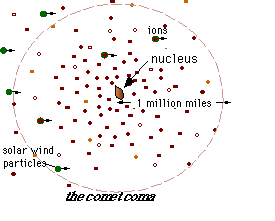
The Comet Coma

As the ices of the comet nucleus evaporate, they expand rapidly into a large cloud around the central part of the comet. This cloud, called the coma, is the atmosphere of the comet and can extend for millions...more

Shop Windows to the Universe

Young Voices for the Planet DVD in our online store includes 8 films where students speak out and take action on climate change.

Windows to the Universe, a project of the National Earth Science Teachers Association, is sponsored in part by the National Science Foundation and NASA, our Founding Partners (the American Geophysical Union and American Geosciences Institute) as well as through Institutional, Contributing, and Affiliate Partners, individual memberships and generous donors. Thank you for your support! NASA AGU AGI NSF