Current Events

  • Atmospheric CO2 Level Tops 400 ppm
    During the week of May 13th, the CO2 level at the Mauna Loa Observatory in Hawaii topped 400 ppm rep...Read more

    x

    Atmospheric CO2 Level Tops 400 ppm

    During the week of May 13th, the CO2 level at the Mauna Loa Observatory in Hawaii topped 400 ppm repeatedly. Daily levels of CO2 can vary due to weather, and there are seasonal trends as well. The level of atmospheric greenhouse gases continues to increase, now over 120 ppm since the Industrial Revolution began. For more on the Keeling Curve, see http://keelingcurve.ucsd.edu/. Find out more about greenhouse gases and warming.
  • Massive Tornado Outbreak on Tornado Alley
    The week of May 19 brings dozens of tornadoes to Tornado Alley in the states of Oklahoma, Kansas, Io...Read more

    x

    Massive Tornado Outbreak on Tornado Alley

    The week of May 19 brings dozens of tornadoes to Tornado Alley in the states of Oklahoma, Kansas, Iowa, Illinois and Missouri. On May 20th, a massive tornado struck Moore, Oklahoma, devastating communities - destroying over 100 homes and hitting two elementary schools and a hospital - with many casualties and deaths. Our thoughts are with our friends and colleagues suffering from these storms. For more on the May 20th storms, see the NOAA Storm Prediction Center Storm Report.
  • Kansas Legislator Proposes Bill to Outlaw Sustainability Education
    A bill has been introduced in the Kansas legislature this week that would prohibit the promotion of ...Read more

    x

    Kansas Legislator Proposes Bill to Outlaw Sustainability Education

    A bill has been introduced in the Kansas legislature this week that would prohibit the promotion of sustainability. Here is a link to the one-page bill: http://www.kslegislature.org/li/b2013_14/measures/documents/hb2366_00_0000.pdf. See report on Bloomberg News.
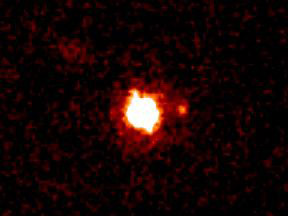
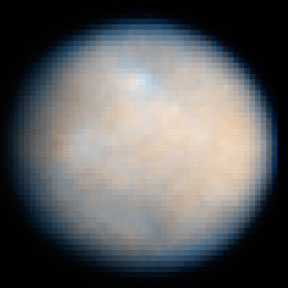
This picture of the asteroid Ceres was made by the Hubble Space Telescope in December 2003 and January 2004. Ceres was declared a "dwarf planet", along with Pluto and Eris, in 2006.
Click on image for full size
Image courtesy of NASA, ESA, J. Parker (Southwest Research Institute), P. Thomas (Cornell University), L. McFadden (University of Maryland, College Park), and M. Mutchler and Z. Levay (STScI).

Ceres: Asteroid and Dwarf Planet

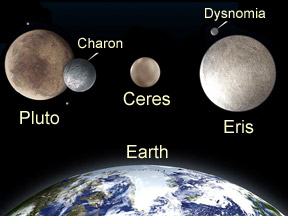
Ceres is the largest asteroid in the main asteroid belt. It was classified as a "dwarf planet" in 2006, along with Pluto and Eris. Ceres was discovered on January 1, 1801 by the Italian astronomer and monk Giuseppe Piazzi.

Ceres has a diameter of about 975 km (605 miles). It is by far the largest and most massive body in the main asteroid belt, and contains about a third of the belt's total mass. Ceres orbits the Sun once every 4.6 years. Its orbit lies between the orbits of Mars and Jupiter. The asteroid turns on its axis once every 9 hours, so that's how long a day is on Ceres.

Last modified November 28, 2007 by Randy Russell.

Shop Windows to the Universe Science Store!

Our online store includes books on science education, classroom activities in The Earth Scientist, mineral and fossil specimens, and educational games!

Windows to the Universe Community

News

Opportunities

You might also be interested in:

Cool It! Game

Check out our online store - minerals, fossils, books, activities, jewelry, and household items!...more

Dwarf Planets

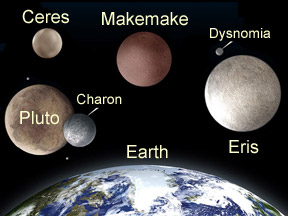
In 2006 the International Astronomical Union (IAU) approved a new classification scheme for planets and smaller objects in our Solar System. Their scheme includes three classes of objects: "small solar...more

Pluto

Pluto is a frigid ball of ice and rock that orbits far from the Sun on the frozen fringes of our Solar System. Considered a planet, though a rather odd one, from its discovery in 1930 until 2006, it was...more

Eris - a dwarf planet

Eris is a dwarf planet in our Solar System. Eris was one of the first three objects classified as a dwarf planet, along with Pluto and Ceres. Eris was first spotted in January 2005. Eris is a large sphere...more

Elliptical Orbits

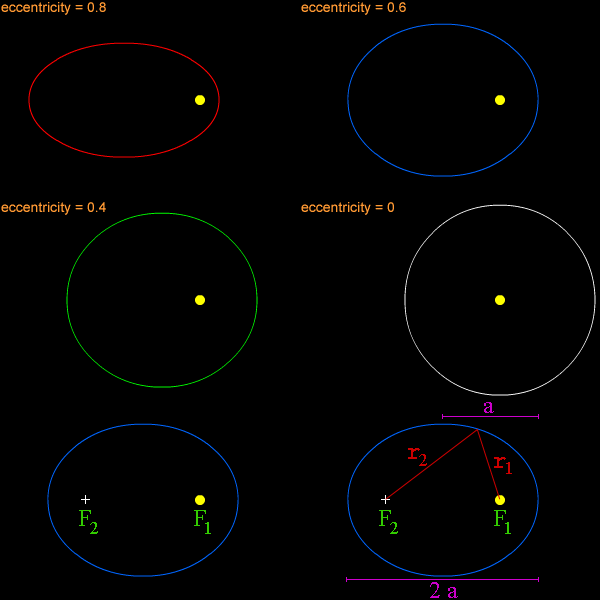
You may think that most objects in space that orbit something else move in circles, but that isn't the case. Although some objects follow circular orbits, most orbits are shaped more like "stretched...more

Makemake: a Dwarf Planet

Makemake is a dwarf planet in our Solar System. Makemake was discovered in March 2005 by a team of astronomers led by Mike Brown. Makemake officially became a dwarf planet in July 2008. There were three...more

Asteroid Toutatis

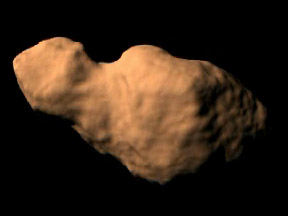
Toutatis is a very strange asteroid. It has a strange shape, and it spins in a very unusual way. Sometimes Toutatis comes close to Earth. This asteroid is shaped sort of like a potato. Its size is 1.92...more

Asteroid Lutetia

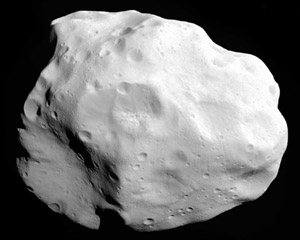
Lutetia is a medium-sized asteroid. It orbits the Sun in the main asteroid belt between the planets Mars and Jupiter. Its official name is "21 Lutetia" because it was the 21st asteroid discovered. Lutetia...more

Shop Windows to the Universe

Ready, Set, SCIENCE!, by the National Research Council, focuses on K-8 science classsrooms. Check out the other publications in our online store, as well as classroom materials.

Windows to the Universe, a project of the National Earth Science Teachers Association, is sponsored in part by the National Science Foundation and NASA, our Founding Partners (the American Geophysical Union and American Geosciences Institute) as well as through Institutional, Contributing, and Affiliate Partners, individual memberships and generous donors. Thank you for your support! NASA AGU AGI NSF